


Editorial team · Food, Drinks
 InfoWeb Marketplace · Editorial team
Published on 1 August 2012 · 2 min read
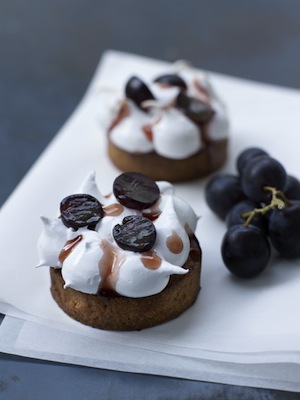
PDO Muscat du Ventoux, a renowned grape
InfoWeb Marketplace · Editorial teamPublished on 1 August 2012 · 2 min read
Among table grapes, not everyone can be PDO!
In the 15ème century, the King of Naples and Sicily, better known as the Good King René, brought the moscato di Amburgo grape (named after a village near Florence) to France and planted it in Provence, where he was also count. Muscat du Ventoux, one of the only French grapes to earn PDO certification, is a variety of this Muscat of Hamburg.
Picked and carefully sorted on site from late August to mid-November, this grape has a thin, beautiful blue-black skin covered with a delicate layer of bloom. Its subtle, musky flavor is very thirst-quenching. It contains B vitamins, potassium and polyphenols.
An exceptional fruit that deserves a place of honor on the table.
A TERROIR OFFERING THE IDEAL CONDITIONS FOR AN EXCEPTIONAL GRAPE
Grown in a terroir with exceptional sunshine at the foot of Mont Ventoux, the black PDO Muscat du Ventoux grape ripens on the hillsides of 56 municipalities, at 200 meters of altitude.
The PDO area extends over 1 200 hectares covering the Comtat plain and the Calavon valley.
Easily recognizable by its bluish-black color, its smooth texture and its sweet, musky flavor, PDO Muscat du Ventoux offers an astonishing palette of sensations on the palate, ranging from sweet to tangy, and releases aromas with floral notes such as rose and violet, and red fruit notes such as blackcurrant and raspberry
MUSCAT DU VENTOUX IS ONE OF ONLY TWO FRENCH GRAPES BENEFITING FROM THE OFFICIAL PDO QUALITY LABEL.
The Appellation d'Origine Contrôlée (AOC), obtained in 1997, and the European-level Protected Designation of Origin (PDO), awarded in 1999, are for Muscat du Ventoux the official marks of a quality that meets very strict criteria.
A very strict set of specifications:
The harvest cannot begin before the ripeness index has reached a minimum of 18° Brix (corresponding to the sugar fraction in the grape).
The grape variety must be exclusively Muscat of Hamburg.
Pruning, planting density and irrigation are also controlled.
Bunches must weigh at least 250 g, have a sugar content of 169,3 g/l and be well formed with loose berries, a bluish color and intact bloom, the fragile little layer of wax that the fruit naturally secretes to protect itself from the sun and which is a guarantee of freshness.
Sorting is done directly during picking. The bunches are trimmed (bad berries are carefully removed with scissors) and then delicately placed in punnets and trays bearing the AOP Muscat du Ventoux logo, as well as the producer's identification number.
WELL-BEING: A TREASURE OF BENEFITS
Sweet and full of sunshine, the grape is the fruit of vitality. Thirst-quenching, it also contains B vitamins, potassium and polyphenols.
HOW TO STORE IT
Grapes can be kept for 5 days in the vegetable drawer of the refrigerator, wrapped in a plastic bag. Take them out an hour before eating: the cold neutralizes the flavor of this delicate fruit. Simply rinse under running tap water, then drain before enjoying.
Advertisement