


Editorial team · Welcome products
 InfoWeb Marketplace · Editorial team
Published on 8 October 2013 · 4 min read
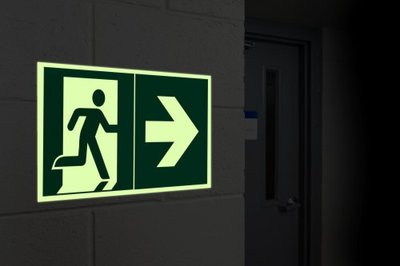
Brady safety signs with photoluminescent pictograms and tapes
InfoWeb Marketplace · Editorial teamPublished on 8 October 2013 · 4 min read
Glow-in-the-dark pictograms and tapes to support your guidance system for safety evacuations
An emergency evacuation plan that is regularly rehearsed through simulation drills allows you to get your staff out quickly and safely in a crisis.
When an entire office building or production plant is plunged into darkness, perfectly visible safety signage such as pictograms and markers increases the chances of evacuating everyone unharmed.
?If sensibly positioned, high-quality safety signage will keep glowing to guide firefighters dealing with the disaster through the site in the event of a general power failure,? explains Dominique Roosen, EMEA Product Manager for Safety & Facility Identification Solutions at Brady Corporation, an international manufacturer and distributor of safety signage equipment.
Choosing a photoluminescence class
Photoluminescent materials are divided into different categories (or classes) according to their luminosity in the dark after 10 and 60 seconds. Class A covers basic photoluminescent materials, with a afterglow of 23 mcd/m² after 10 minutes and 3 mcd/m² after one hour. ?Brady's NiteGlo brand is a class B photoluminescent offering, with an afterglow of 50 mcd/m² after 10 minutes and 7 mcd/m² after one hour. Our XtraGlo brand is a class C photoluminescent material, with 140 mcd/m² after 10 minutes and 20 mcd/m² after one hour in the dark.?
?Photoluminescence classes give a clear overview of the quality available when ordering, depending on your needs. Remember that many countries have issued guidelines or adopted standards governing the minimum luminescence of photoluminescent safety signage,? stresses Dominique Roosen. ?Brady can help you choose the photoluminescence class best suited to your needs.?
Guidance systems for safety escape routes
?Photoluminescent materials are mentioned in the ISO 16069, ANSI and DIN 67510 standards, which aim to standardize guidance systems for safety escape routes worldwide. ISO 16069 sets out the general principles applicable to both electrical and photoluminescent components. It provides specific information related to the type of component, to help define the usage environment, material choice, layout, installation and maintenance.?
In some cases, electroluminescent signage can be used in combination with electrical elements. Electroluminescent materials also have the advantage of not incurring additional inspection and maintenance costs.
Photoluminescent signage materials
?At Brady, we offer several electroluminescent signage materials. The choice of material depends on where you wish to place your safety signage.
Self-adhesive polyester: ?This material is easy to apply and thin enough for small safety signs. Self-adhesive polyester requires a clean surface for the safety signage to adhere to.?
Rigid polypropylene: ?Rigid polypropylene is used for larger safety signs, such as emergency exit symbols at trade shows. It is mainly intended for indoor use. The standard material is not adhesive, but can be fixed to rougher surfaces using a suitable glue.?
Aluminium: ?Aluminium is mainly for outdoor use and is also very practical on magnetic panels or on machines.?
Other materials, such as self-adhesive polypropylene, are also available.
Best practices for photoluminescent applications
Well-placed photoluminescent safety signage in a corridor, production workshop, open-plan office or large area covers three heights.
Floor-level signage such as photoluminescent tape shows staff the way to the exit when smoke builds up or in a fire. Fixed at floor level or on the wall at a height not exceeding 40 cm, it indicates the most direct escape route, even if people have to bend down to avoid inhaling too much smoke. Brady recommends marking both sides of a corridor if it is more than two metres wide.
Mid-level signage is placed between 1,2 m and 1,5 m. These signs carry more information, such as a plan showing where the nearest fire extinguisher or staircase is, the direction in which doors open, or the location of the first aid kit. These photoluminescent signs and shapes are placed at ideal reading height.
High-level signage, above 1,80 m, allows staff to spot the nearest emergency exit from a distance. It also helps people stay calm and composed because it remains visible, even when hundreds of employees rush to the nearest exit at the same time.
Once these three heights are covered, make sure to clearly mark obstacles or clearance routes using photoluminescent tapes, shapes or accessories. In an evacuation, staff will then be able to use stairs in the dark more easily, avoiding meeting rooms, furniture or office pillars, and machines in production areas, so as to reduce the risk of injury from falling or hitting hard objects.
Brilliant safety stars
High-quality photoluminescent safety signage is used to mark obstacles and clearance routes for rapid evacuation. It still glows sufficiently after an hour in the dark to guide firefighters through the premises once staff have been evacuated.
Photoluminescent materials charge by exposure to light (daylight being the ideal source) and require no inspection or maintenance. They glow in the dark and guide people safely to the exit, even in the event of a general power failure.
To find out more, visit our website www.bradyeurope.com, or email us at emea_request@bradycorp.com to receive our brochure on photoluminescent signs and tapes.
Quotes to highlight
?High-quality photoluminescent material still glows sufficiently after an hour in the dark to guide firefighters through your premises.?
?Well-placed photoluminescent safety signage covers three heights.?
Quotes from Dominique Roosen, EMEA Product Manager for Safety & Facility Identification Solutions at Brady Corporation.
Advertisement